
HBL Insights
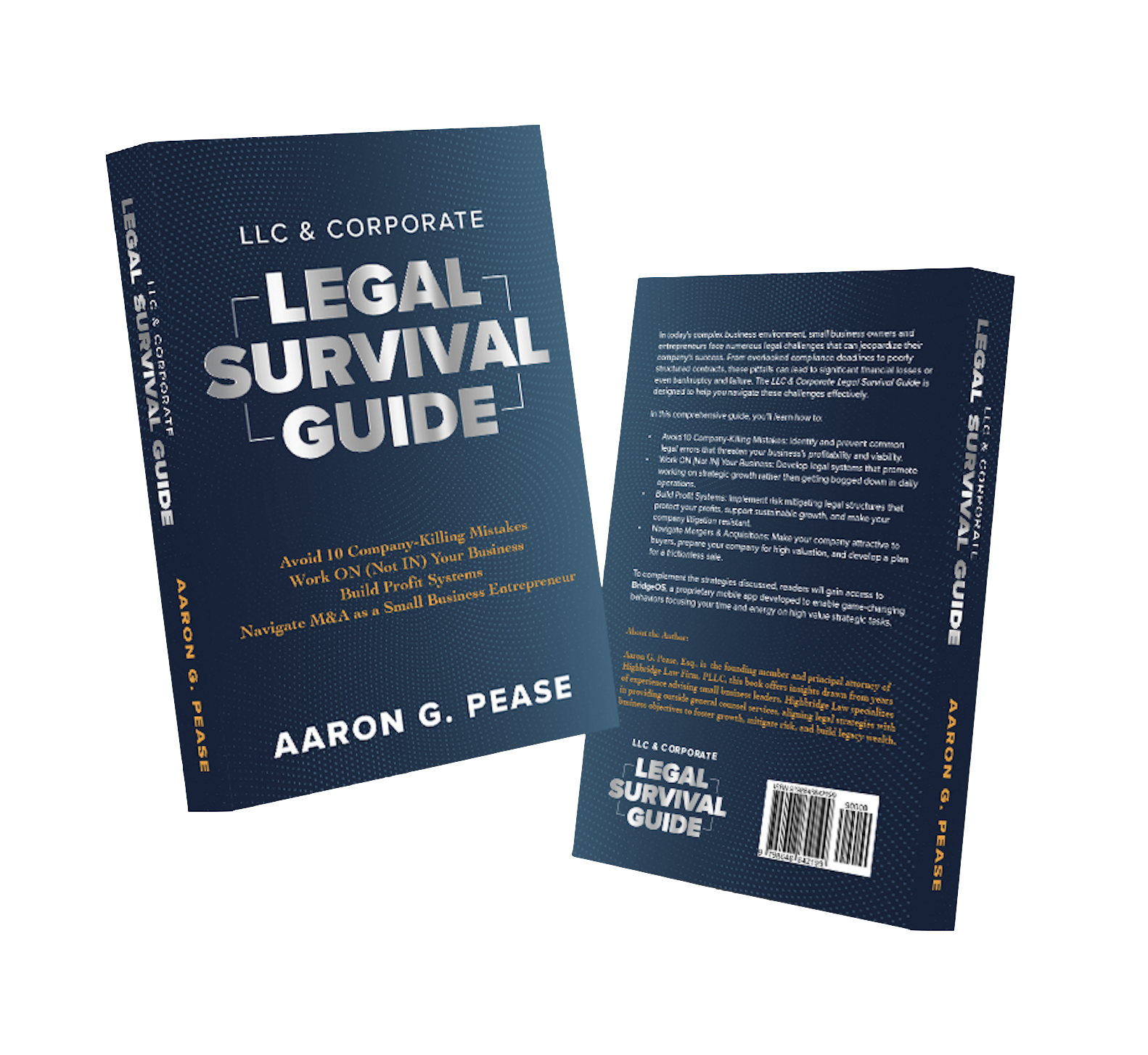
Protect What You’ve Built. Unlock What’s Next.
Running a business today means navigating a maze of legal and operational risks—many of which can quietly drain your profits, stall your growth, or even threaten your company’s survival.
That’s why we created The LLC & Corporate Legal Survival Guide—a powerful resource designed specifically for business owners and entrepreneurs who want to safeguard their companies and position them for long-term success.
In this practical, easy-to-use guide, you’ll learn how to:
Avoid common legal traps that jeopardize small and midsize businesses
Build smart systems that protect your revenue and reduce litigation risk
Strengthen contracts, partnerships, and company operations
Prepare your business for future growth, sale, or transition
At Highbridge Law, we believe that great legal counsel doesn’t just protect your downside—it amplifies your upside. This book is your roadmap for doing just that.
Ready to take the next step?
This guide will help you work on your business—not just in it—so you can move forward with clarity and confidence.

Discover BridgeOS™
Close the AI Speed to Decision Control Gap
Work Smarter. Lead Stronger. Grow Faster.
Artificial intelligence is changing how decisions are made — not just how fast.
But in many organizations, governance has not kept pace with execution.
AI rarely “makes decisions” on its own. Instead, it reshapes accountability, obscures ownership, and accelerates outcomes faster than traditional oversight models were designed to handle. That gap — between decision velocity and governance readiness — is where risk quietly accumulates.
BridgeOS™ was created to help leadership teams and boards recognize that moment early.
Ready to level up?
Visit BridgeOS.app and discover how to transform the way you lead your business.
Decision Readiness in an AI-Accelerated Organization
BridgeOS begins with a short AI Decision Readiness Self-Assessment — a structured reflection tool designed for executives, general counsel, and board members navigating AI-affected decisions.
The assessment is not a compliance checklist and it is not scored.
Its purpose is to surface a more fundamental question:
Are AI-influenced decisions in your organization being governed at the level of seriousness their consequences actually require?
Through guided prompts, leaders examine:
Who truly owns AI-influenced outcomes
Which decisions are reversible — and which are not
Where governance exists to create comfort rather than control
Whether AI-affected decisions can be explained, challenged, and revised
When operational judgment becomes legal, fiduciary, or reputational risk
Many organizations discover that they did not move too quickly —
they moved forward without realizing the decision had become consequential.
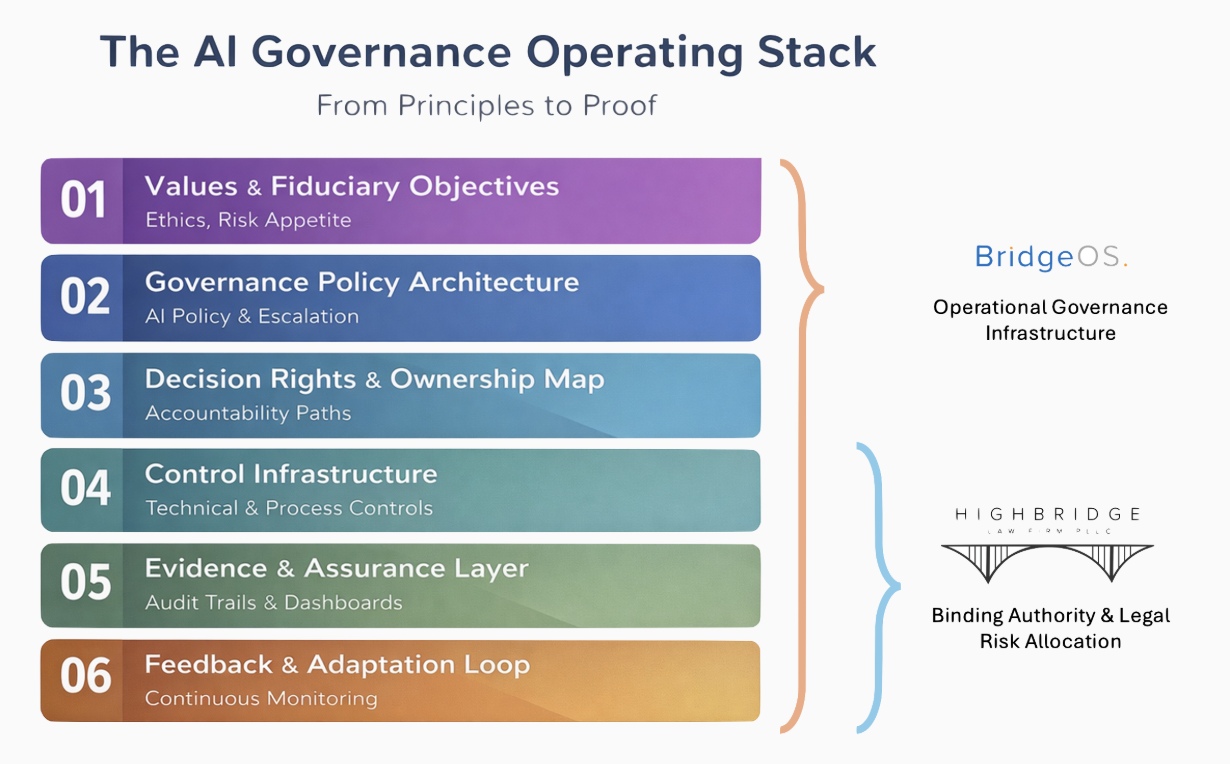
The Transition to Legal Oversight
At a certain point, AI-affected decisions stop being purely operational and become matters of:
fiduciary duty,
regulatory exposure,
contractual risk,
or public accountability.
That is where Highbridge Law steps in.
Highbridge Law works with clients when governance choices must be translated into binding legal structures, enforceable controls, and defensible risk allocation — supporting organizations as decisions move from internal judgment to external scrutiny.
BridgeOS and Highbridge Law are intentionally complementary:
BridgeOS helps leaders recognize when governance must change.
Highbridge Law helps ensure it holds up when it matters most.
Organizations rarely encounter governance failure because they move too slowly.
They encountered it because they moved forward without realizing how serious the decision had become.
BridgeOS is designed to help leadership teams recognize that moment — early.
Explore the AI Decision Readiness Self-Assessment at BridgeOS.app
Where BridgeOS Fits
BridgeOS operates before formal legal obligation attaches — before:
policy drafting,
regulatory interpretation,
compliance reviews,
vendor commitments,
or escalation to outside counsel.
The focus is on clarifying:
decision ownership,
governance alignment,
escalation thresholds,
and responsibility boundaries
while there is still room to act deliberately.